
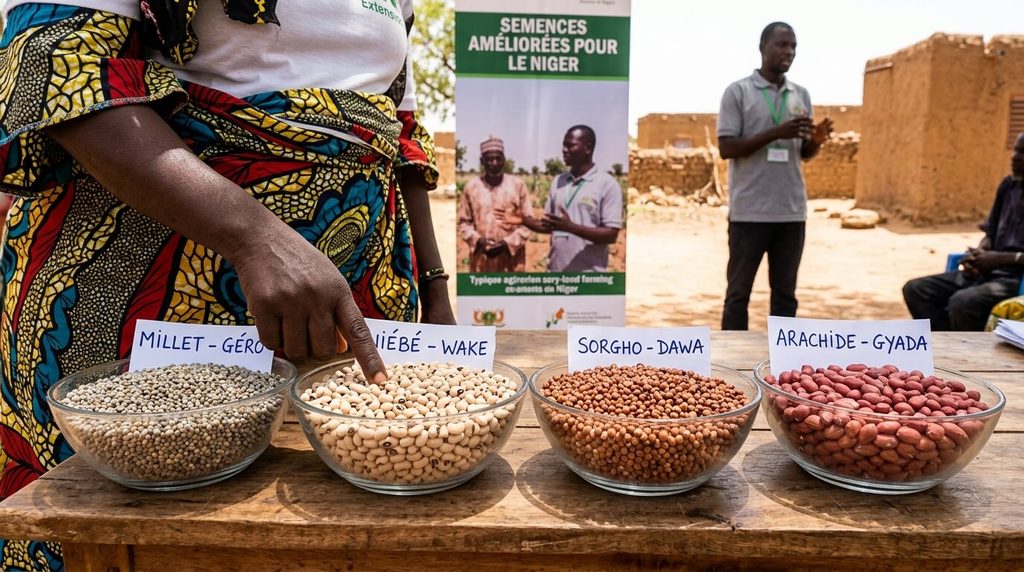
Introduction
The use of improved seeds in Niger is growing, but adoption remains limited. Indeed, supply does not cover all needs and access is still difficult. This article reviews supply, adoption, barriers and priorities for millet, sorghum, cowpea and maize.
Key takeaways
- In 2022, 35 varieties of millet, sorghum, cowpea and maize were available on the Nigerien market.
- Quality seed supply covered 45% of millet needs, 21% of cowpea needs and 9% of sorghum needs.
- According to a study published in 2024, about 30% of surveyed households grew improved millet.
- Farmer field schools markedly increase adoption.
Why improved seeds in Niger are a major issue
In Niger, rainfed agriculture is central to the lives of rural households. It also shapes their food security. Therefore, access to quality seed is an important lever to produce more and cope better with climate shocks.
Improved varieties offer traits that farmers look for. For example, they can mature earlier, yield more or tolerate certain stresses better. However, improved seeds in Niger are still used unevenly across crops and areas.
Moreover, no single figure sums up the national situation. Indeed, studies cover different crops, areas and indicators. We must therefore distinguish variety adoption, certified seed use and the share of planted area.
Improved seeds in Niger: key terms
Before looking at the figures, a few terms need clarifying:
- Improved variety: a variety bred, for example at INRAN, for early maturity, yield or tolerance.
- Certified seed: a seed lot whose purity, germination and health have been officially checked.
- Quality declared seed: its quality is declared by the producer, then verified through lighter checks.
- Formal system: an organized chain from research to sale, with registered seed producers.
- Informal system: seed saved on the farm, swapped with neighbors or bought at the market.
Thus, a seed can be of an improved variety without being certified. Similarly, a well-stored local variety can be of good quality.
The supply of improved seeds in Niger is still insufficient
The TASAI report on Niger analyzes the 2022 season. It describes a growing formal seed sector. However, most farmers still rely on the informal system.
The report lists 35 varieties on the market in 2022 for four priority crops:
- Millet: 15 varieties and 9,238 tonnes, or 45% of estimated needs.
- Sorghum: 7 varieties and 1,027 tonnes, or 9% of needs.
- Cowpea: 11 varieties and 1,811 tonnes, or 21% of needs.
- Maize: 2 varieties and 67 tonnes, or 81% of needs.
These figures measure commercial seed supply. Therefore, they do not measure adoption by farmers.
The contrast is clear. On the one hand, supply covers most maize needs, a secondary crop in Niger. On the other hand, it remains low for millet, sorghum and cowpea, the country’s major crops.
Adoption of improved seeds in Niger: what do studies say?
Surveys show real but highly variable adoption:
- Millet (study published in 2024): 30.65% of surveyed households grew improved varieties, on 30.15% of the millet area.
- Cowpea (2015–2016 survey, 612 households): the adoption rate reached 39.7% in the sample.
- Farmer field schools (south-central Niger): 77.2% adoption of HKP millet among trained farmers.
- Same program: 73.5% adoption of IT90K-372-1-2 cowpea.
Sources: npj Sustainable Agriculture, 2024, Issoufou et al., 2017 and Rabe et al., 2022.
These results cover specific samples. Therefore, they do not represent the whole country. However, they point the same way: improved varieties are known, but local varieties remain the majority.
The field school results are particularly telling. Indeed, adoption rates were markedly lower in control villages. In other words, when farmers test varieties themselves, adoption rises sharply.
Why improved seeds in Niger are still rarely used
Insufficient availability
The volumes produced do not cover needs, especially for sorghum, cowpea and millet. Moreover, seed is sometimes far from villages. It may also be unavailable at sowing time.
Cost and credit
Even when appreciated, seed can be too expensive for a household. This is especially true when seed is needed for several crops. Consequently, access to credit and farmer organizations plays a key role.
Farmers’ trust
Farmers judge a variety on concrete criteria. For example, they look at cycle length, yield stability and grain quality. They also consider storability and food uses. Thus, a variety that performs well elsewhere is not always the best locally.
Lack of advice
Finally, information remains decisive. Field schools show that training encourages adoption. Seed availability must therefore go hand in hand with demonstrations and field follow-up.
Progress in research to build on
The sector has real strengths. According to the TASAI report, INRAN has at least one plant breeder for each of the four priority crops. In addition, 16 new varieties were released in 2023. Nevertheless, research programs still lack funding and infrastructure.
The challenge now is to link research with regular seed production. Quality control, distribution and advice must also be strengthened. To do this, seed producers, cooperatives and seed companies need more support.
How to speed up the adoption of improved seeds in Niger
Several priorities emerge from the available studies:
- Produce closer to demand: develop decentralized production of certified or quality declared seed.
- Build networks: connect seed producers, research, technical services, farmer organizations and companies.
- Show before scaling up: multiply participatory trials and demonstration plots.
- Improve access: anticipate demand and open nearby sales points.
- Tailor advice: take farmers’ preferences and market outlets into account.
- Measure better: track supply, quality, adoption and planted area separately.
ASTRA’s role for improved seeds in Niger
ASTRA wants to bring research, innovation and farmers closer together. To do so, the NGO works with research institutes, universities and technical services. It also involves local authorities and farmer organizations.
In practice, ASTRA first aims to identify suitable varieties. Next, it wants to support participatory trials. Finally, it wants to improve access to quality seed, as set out in our programs.
However, distributing seed is not enough. ASTRA therefore combines seed with broader support: good practices, soil fertility, crop protection and monitoring. On this topic, read our analysis of agroecological inputs.
Are you a researcher, seed producer, cooperative or donor? Partner with ASTRA and help us make quality seed accessible.
Frequently asked questions about improved seeds in Niger
What is the difference between improved seed and certified seed?
An improved variety comes from plant breeding. Certified seed is a lot checked by the official services. Thus, a seed can be improved without being certified.
How many varieties of improved seeds in Niger are available?
According to the TASAI report, 35 varieties of millet, sorghum, cowpea and maize were on the market in 2022. In addition, 16 new varieties were released in 2023.
Why does adoption remain limited?
Mainly because of insufficient supply, cost, distant sales points and a lack of advice.
How can adoption be accelerated?
First, by producing quality seed locally. Then, by multiplying demonstrations and strengthening agricultural advice.
Conclusion
The use of improved seeds in Niger cannot be summed up in a single figure. The formal sector is growing, but supply remains insufficient for several crops. Moreover, adoption remains partial and variable.
Yet training and demonstration give encouraging results. The challenge is therefore to offer suitable varieties, available on time and at an affordable cost. In addition, these seeds must come with reliable advice. This is where ASTRA aims to act.
References
- TASAI (2024). Niger Country Report – 2022 study. The African Seed Access Index. https://tasai.org/tasai-blog/niger-country-report-launch/
- Seed Sector Performance Index (2023). Seed Sector Performance Index Status Report 2023 (2022 seed production data). https://cessa.agra.org/wp-content/uploads/2024/09/Seed-Sector-Perfomance-Index-status-report_2023_web.pdf
- Tradeoffs between the use of improved varieties and agrobiodiversity conservation in the Sahel (2024). npj Sustainable Agriculture. https://www.nature.com/articles/s44264-024-00038-w
- Issoufou, O. H. et al. (2017). Modélisation des décisions des agriculteurs sur l’adoption et l’intensification des semences améliorées du niébé au Niger. Revue Marocaine des Sciences Agronomiques et Vétérinaires. https://www.agrimaroc.org/index.php/Actes_IAVH2/article/view/479
- Rabe, M. M. et al. (2022). Évaluation de l’effet de l’approche champ école paysan sur l’adoption des technologies améliorées de production du mil et du niébé au centre-sud du Niger. Revue Marocaine des Sciences Agronomiques et Vétérinaires. https://www.agrimaroc.org/index.php/Actes_IAVH2/article/view/1111
- Zakari, S. et al. (2023). Evaluating the impact of improved crop varieties in the Sahelian farming systems of Niger. Journal of Agriculture and Food Research, 14, 100897. https://doi.org/10.1016/j.jafr.2023.100897