
Introduction
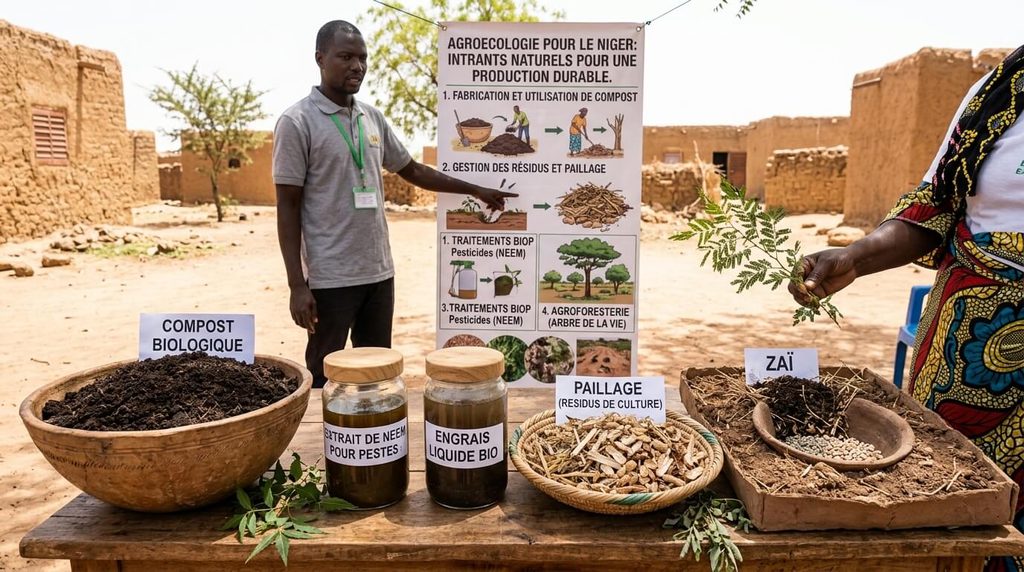
Agroecological inputs in Niger already exist: compost, Bokashi, biochar, biofertilizers and neem-based biopesticides. However, farmers still struggle to access them. This article reviews the available solutions, how widely they are used and how to make them accessible.
Key takeaways
- Agroecological inputs in Niger are diverse: organic manure, compost, Bokashi, biochar and biopesticides.
- Their use remains uneven. In 2020, 62.4% of surveyed farmers used animal manure. Only 2.4% used compost.
- The main barrier is not technical. It is access: availability, cost, labor and advice.
- Farmer organizations such as FCMN-Niya show that local production is possible.
Why agroecological inputs in Niger matter
In Niger, soils are becoming poorer and rainfall is erratic. Moreover, pests and the cost of fertilizer weigh on harvests. As a result, many agro-pastoral families farm poor soils with limited means.
In this context, agroecological inputs in Niger offer a complementary path. Indeed, they can restore soil fertility and help control pests. In addition, they use local resources and make farms more resilient.
The problem, therefore, is not a lack of solutions. In fact, technologies are already documented, tested by researchers or used by farmer organizations. The real challenge is to make them accessible, affordable and backed by good advice.
Agroecological inputs in Niger: what are we talking about?
An agroecological input is used to fertilize the soil or protect crops. It relies on natural processes and, most often, on local resources. Unlike synthetic fertilizer, its first aim is to improve the soil over time.
Here are the main agroecological inputs in Niger:
- Animal manure: livestock droppings that add organic matter and nutrients.
- Compost: crop residues, manure and waste decomposed under controlled conditions.
- Bokashi: an organic fertilizer made by fermentation with microorganisms.
- Biochar: plant-based charcoal, for example from rice husks, that holds water and nutrients.
- Biofertilizers and liquid compost: preparations that stimulate soil life.
- Biopesticides: preparations made from local plants, in particular neem.
- Rock phosphate: local rock used as a soil amendment or to coat seed.
These inputs complement other practices, such as crop rotation, live hedges, mulching and zaï pits. Their effectiveness therefore often depends on how they are combined.
Agroecological inputs in Niger that are already available
For soil fertility
Farmers can use animal manure, compost, Bokashi or biochar. These solutions make use of farm residues. Thus, they return to the soil part of the nutrients removed by harvests.
For crop protection
Neem-based biopesticides reduce dependence on synthetic pesticides. Furthermore, integrated pest management, intercropping and live hedges limit pest pressure.
The FCMN-Niya experience
The Federation of Market Gardening Cooperatives of Niger (FCMN-Niya) has produced biofertilizers since 2018, with support from the TAPSA program. In particular, it makes compost, Bokashi, NPK Bio and carbonized rice husks. It also produces biopesticides from local plants. In July 2025, it published a booklet on biopesticide production.
This experience shows that local production of agroecological inputs in Niger is possible. For this reason, the model deserves to be strengthened and adapted to other areas.
What research shows
A study published in 2020 surveyed 220 farmers in Maradi, Tahoua and Tillabéri. It also tested mechanized sowing, seed preparation and localized fertilization. As a result, it found that suitable technical packages can improve yields and margins. Moreover, they shorten the crop cycle.
In this study, coating millet seed with Niger rock phosphate gave better results than the control. However, this is a trial result. It therefore does not prove that the product is already accessible to farmers.
Use of agroecological inputs in Niger: a mixed picture
The data show that these practices are not used to the same extent. For example, three recent studies report the following results:
- Maradi, Tahoua and Tillabéri (2020, 220 farmers): 62.4% used animal manure, 2.4% compost and 0.65% mulching.
- Peri-urban areas (2025, 142 farmers): biopesticides are among the most used solutions in dry-season vegetable growing.
- Boboye (2020, 75 farmers): biochar, Bokashi and compost are used, but large-scale adoption remains difficult.
Sources: Issa et al., 2020, Tambol et al., 2025 and Djabri et al., 2020. These figures describe study samples. Therefore, they are not national rates.
The gap between manure and compost is telling. Indeed, manure is available on the farm. In contrast, compost requires raw materials, water, labor and know-how. Consequently, access and effort matter more than knowing the technique.
Thus, two common misconceptions should be avoided. On the one hand, agroecological inputs in Niger are not absent. On the other hand, they are not yet widely adopted. In fact, their spread remains uneven, local and poorly documented at national level.
Access to agroecological inputs in Niger: four barriers
1. Availability
A farmer may know about a solution but be unable to find it nearby. Moreover, compost and biopesticide production units are often small. In addition, sales channels for biological inputs are less developed than those for conventional inputs.
2. Cost
Making an input on the farm reduces purchases. However, it requires labor, water, equipment and time. For commercial products, price and transport also limit purchases. An effective technology is therefore not always affordable for a household.
3. Labor and know-how
Preparing compost or a biopesticide requires the right ingredients, rates and conditions. Otherwise, the product loses its effectiveness. Furthermore, zaï pits and mulching are labor-intensive, especially without suitable equipment.
4. Advice and follow-up
Farmers need to know which product to use, on which crop, at what rate and when. Yet results vary with soil, climate and the quality of implementation. Thus, without demonstration and follow-up, the risk of failure increases. As a result, so does the risk of abandonment.
How to improve access to agroecological inputs in Niger
Trials in Niger show agronomic and economic benefits. However, moving from trials to adoption takes more. First, production must be organized and quality guaranteed. Then, distribution channels are needed, costs must fall and farmers need long-term support.
Several levers can therefore be combined:
- Produce locally: support community units producing compost, Bokashi and biopesticides.
- Train: support cooperatives, young entrepreneurs and small businesses, from quality control to sales.
- Distribute close to farmers: open sales points with farmer organizations and suppliers.
- Demonstrate: set up demonstration plots and participatory trials.
- Equip: improve access to shredders, composters, sprayers and small tools.
- Finance: create mechanisms suited to smallholders and small production units.
- Advise: share reliable information on rates, timing and precautions.
- Measure: track the availability, prices, quality and actual use of inputs.
Similarly, the study published in 2025 recommends stronger links between farmers, extension services, INRAN and universities.
ASTRA’s role for agroecological inputs in Niger
ASTRA wants to close the gap between the existence of these technologies and real access to them. To do so, the NGO seeks to work with research institutes, universities, government services and local authorities. It also wants to involve farmer organizations, input suppliers and the private sector.
In practice, ASTRA first plans to identify solutions suited to each agroecological zone. Next, it aims to run participatory trials and train farmers. Finally, it wants to support local production of quality inputs and nearby supply channels. These actions are part of our areas of work.
For ASTRA, the agroecological transition does not rest on technology alone. Indeed, it requires local systems able to produce, control, distribute and support. The goal is therefore clear: to move innovations from research stations to farmers’ fields.
Are you a researcher, farmer organization, supplier or donor? Partner with ASTRA and help us make these solutions accessible.
Frequently asked questions about agroecological inputs in Niger
What is an agroecological input?
It is a product that fertilizes the soil or protects crops through natural processes. For example, compost, Bokashi, biochar or plant-based biopesticides.
What is Bokashi?
Bokashi is an organic fertilizer made by fermenting organic matter. In Niger, FCMN-Niya produces it, in particular with support from the TAPSA program.
Why are agroecological inputs in Niger still rarely used?
Mainly because of access. Indeed, products are scarce locally, preparation takes labor and technical advice is often lacking.
Can these inputs replace mineral fertilizer?
Not always. They improve the soil over time, but the nutrients they supply may be insufficient. For this reason, trials in Niger often combine organic inputs with localized fertilization.
Conclusion
Niger is not starting from scratch. In fact, knowledge, technologies and farmer initiatives already exist. The experience of FCMN-Niya and research findings both show this.
The main challenge now is access. Agroecological inputs in Niger must become available, affordable, reliable and backed by good advice. To achieve this, local production, farmer organizations and links between research and the field must be strengthened.
Read also: Improved seed use in Niger: growing adoption, but access and availability remain major constraints
References
- Issa, A. I. M. N., Saidou, A. K. & Aune, J. B. (2020). Farmers’ Soil Fertility Management in Niger and Opportunities for Improvements Through Mechanization, Microdosing, and Seed Coating. Frontiers in Sustainable Food Systems, 4:570561. https://doi.org/10.3389/fsufs.2020.570561
- Tambol, T., Derbile, E. K. & Soulé, M. (2025). Use of climate smart agriculture technologies in West Africa peri-urban Sahel in Niger. Scientific Reports, 15, 2771. https://doi.org/10.1038/s41598-024-82813-w
- FCMN-Niya / RECA-Niger (2025). Booklet on FCMN-Niya’s experience in biopesticide production (Livret de capitalisation des expériences de la FCMN-Niya sur la fabrication des biopesticides). July 2025. https://reca-niger.org/spip.php?article2041
- Djabri, H. H., Abdou, M. M. & Mayaki, Z. A. (2020). Perception paysanne et pratiques agro-écologiques dans le Boboye au Niger. Afrique Science, 16(4). https://www.afriquescience.net/article.php?code=Vol.16%2C+N%C2%B04+%282020%29&id=18&nid=718
- Inter-réseaux Développement rural. L’émergence de l’agroécologie au Niger : contraintes et perspectives de diffusion. https://www.inter-reseaux.org/publication/63-66-agroecologie-en-afrique-de-louest-et-du-centre-realites-et-perspectives/lemergence-de-lagroecologie-au-niger/